The Gold Standard for Treating Large Varicose Veins
EVLA & RFA
EVLA & RFA
Endovenous Treatments can be divided into two categories:
- Thermal treatments that use laser energy or radio frequency waves to treat the vein and tumescent anesthesia to protect tissues surrounding the vein during the procedure.
- Non-thermal, non-tumescent (NTNT) treatments, which are procedures that do not require the use of heat or tumescent anesthesia.
Thermal endovenous treatments include endovenous laser ablation (EVLA), also called endovenous laser therapy (EVLT™), and radio frequency ablation (RFA). These are minimally invasive treatments used to address specific large varicose veins in the legs. It is considered the gold standard in treatment of named veins, such as the great and small saphenous veins. It has largely replaced previous, more invasive standards of care, such as vein stripping.
Endothermal ablation has opened the door for many patients with venous disorders to eliminate symptoms and improve their appearance with minimal time investment and minimal pain. Endothermal ablation is an outpatient procedure performed with local anesthetic.
EVLA & RFA at a Glance
- What it treats: Large varicose veins in the legs, and is the gold standard in treatment of named veins, such as the great and small saphenous veins.
- How it works: The heat source is turned on, sealing the vein shut from the inside, and the vein is reabsorbed by the body.
- The Process: An outpatient procedure performed with local anesthetic.
- Recovery: Patients are able to return to work the next day with limited restrictions.
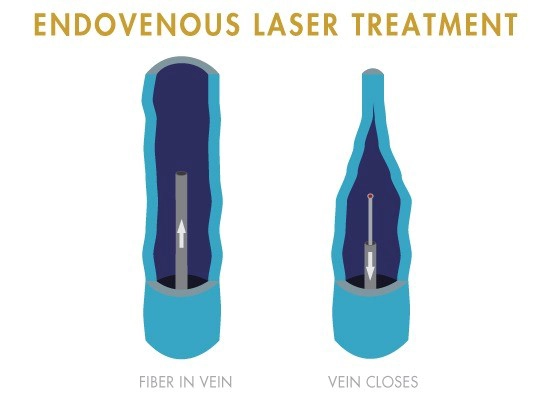
Endothermal Ablation
The procedure begins with the placement of an access port or an IV access placed directly into the problematic vein. Prior to the placement, the skin is numbed with a small amount of local anesthetic. Once access is established, a laser fiber is threaded into the vein up to the place where health meets disease. This can't be felt because the inner walls of the veins do not have sensory receptors. Once in position, more numbing medicine is added around the outside of the vein.
Once the leg is numb, the heat source is turned on, sealing the vein shut from the inside. The vein eventually is reabsorbed by the body and will no longer be visible on the surface of the leg. Blood is diverted to the healthy vein that was essentially leaking into the damaged one and there is no ill effect from the loss of the troublesome vein. Patients are able to return to work the next day with limited restrictions.
What is Tumescent Anesthesia?
The thermal endovenous treatments involve tumescent anesthesia, a technique in which a high volume of a dilute local anesthetic is infiltrated around the vein. Tumescent anesthesia serves three purposes during thermal ablation:
Patient Comfort
The fluid is an anesthetic, keeping the patient comfortable during the procedure.
Tissue Protection
It creates an insulating ring around the vein and thermal energy source. This protects all surrounding tissues, including nerves and muscles, thus stopping any type of collateral damage.
Enhanced Efficacy
It causes the vein walls to collapse around the thermal fiber, maximizing contact and increasing the effectiveness of the procedure.
The tumescent fluid can be administered in many ways, but at the hand of a trained and proficient physician, the process should not be uncomfortable.
Learn About Your Options
At the Vein Healthcare Center, we use a comprehensive approach to vein health. By evaluating your entire venous system, we can treat venous disorders at their source. If you are having any of the above symptoms, seeing a professional vein specialist for a thorough evaluation will help you determine the severity of your issue and explore options for treatment.
Explore our Treatment Options, or visit our Frequently Asked Questions for answers to common concerns. Contact the Vein Healthcare Center to schedule your evaluation.